Sunday, May 10, 2015

Yahoo is going after a former employee the company claims was spilling its secrets.
The lawsuit alleges that Cecile Lal, who was chief of staff to a vice president at Yahoo, leaked information about the company to journalist Nicholas Carlson for his book "Marissa Mayer and the Fight to Save Yahoo!" The suit was filed in Santa Clara County in California on Wednesday and was first reported by Bloomberg.
Carlson, chief correspondent at the website Business Insider, chronicles in his book the tenure of Yahoo CEO Mayer, a former Google executive, as she's tried to turn around the troubled Internet giant since taking the helm in 2012.
Yahoo says Cecile Lal, a former employee, leaked information to author Nicholas Carlson.Richard Nieva/CNET
Yahoo claims Lal violated her employment agreement by divulging secrets to Carlson through email and phone conversations. The company claims Lal's correspondence with Carlson began in April 2014.
Some of what Lal allegedly leaked was information from Yahoo's weekly "FYI" meetings, which Mayer holds to address goings-on at the company. The meetings include a question and answer session with employees, and transcripts are available on a password-protected site called Backyard. Yahoo said Lal apparently shared her password to the site with Carlson.
"Lal's unapologetic breaches of her confidentiality obligations to Yahoo and Yahoo's trust in her took many forms," the company said in the complaint.
Lal could not immediately be reached for comment. A Yahoo spokeswoman said the company couldn't comment on active litigation.
Source:http://www.cnet.com/

As cities continue to grow at a dizzying rate, commuters are constantly battling ever-increasing congestion on the roads and a lack of parking, just to get to work.
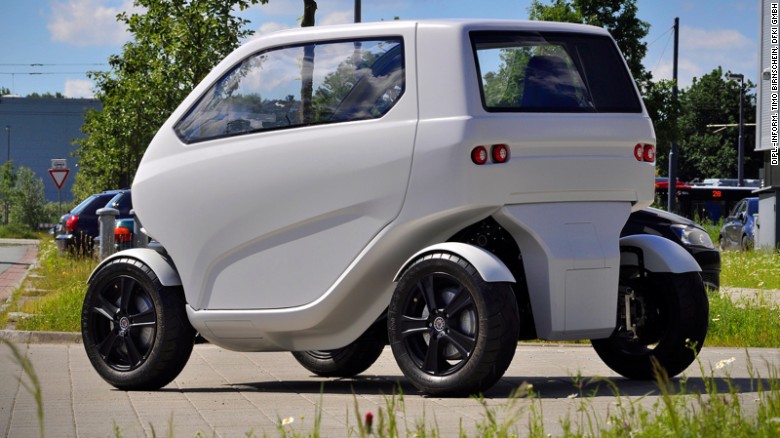
But now a team of German engineers have come up with an ingenious solution -- a "flexible" electric vehicle capable of shrinking, driving sideways (think like a crab) and turning on a dime.
The EO Smart Connecting Car 2 is an innovative design from DFKI Robotics Innovation Center, based in Bremen, Germany, where a team of software developers and designers, as well as electronics and construction engineers, have been refining the smart micro car project for the last three years.
First announced in 2012, the team have moved onto their second iteration of the vehicle. It drives like a traditional car but because each wheel is powered by its own motor, it also has the capability of driving sideways, allowing it to slide into tight spaces in urban areas where parking is limited, explains Timo Birnschein, project manager for the vehicle.
He adds: "The whole process -- the transition between normal driving and driving sideways -- takes about four seconds."

    Shrink and drive

    The prototype has a top speed of 65 km/h (or 40mph) and can travel 50 to 70 kilometers (30 to 44 miles) on a single four-hour full charge of the battery. But it's the two-seater's ability to shrink to around 1.5 meters in length that has the team excited about its uses in future cities, says Birnschien.
    "It is able to reduce it's own size by about 80cm, which makes it almost as small as a bike in length. And with this kind of feature you can go into very tiny parking spaces," he says. "You are still able to turn on the spot, you are still able to drive sideways and you are still able to connect to charging stations, for example."
    EO2 smart car.
    Looking like part "Transformer" and part DeLorean out of "Back to the Future," the car reduces its size by partly folding itself. It shifts the rear axle to the front and slides on a set of rails which raises the interior upwards, while still remaining comfortable for the passenger.
    Touted as a "micro car for a megacity," the team are working hard to make their vehicle roadworthy and envision it as a communal public resource, similar to existing urban car-sharing schemes. The idea is that when you need a car, you could head to your nearest docking station and select the vehicle that's charged enough to drive the distance you need. It would then detach itself and you would be on your way.
    "[It] is very comparable feature-wise to the first prototype," says Birnschein. "The second version is much more reliable and almost road-legal. It's not really, but it's almost there and we are trying to bring this car to the road -- but it's a big hassle to be honest because we have so many new technologies in the car that the technical advisory guys are skeptical."
    He adds that the team have invited several manufacturers to test drive the vehicle, with positive response, but the enthusiasm ends there.
    "The problem is for most car manufacturers, they are not really interested if they didn't invent it themselves. They may buy from Bosch or Siemens or whatever, technology parts like ESP and other things, but not complete systems."
    But his team remain undeterred as they continue working on autonomous features like auto pilot and self parking. Meanwhile Birnschein likens the situation to the rise in smartphones over the last decade -- from non-existence to oversaturation.
    "It will be the same with computer power and autonomy," he says. "In the next 10 years we will most likely see autonomous cars from big car manufacturers -- Mercedes S class will have autonomous functions within three or four years. Some of other manufacturers like GM announced they will have semi-autonomous cars by 2020. And many other car manufacturers are already working on this type of technology.
    "They are driving all the time on the autobahn with autonomous vehicles. I believe it will be coming -- it will be there within the next decade."
    The latest Lenovo LaVie Z 360 laptop won't work as intended in the Tent and Stand modes, but the company ships it anyway, offering a 5 percent refund off the purchase price, says Consumer Reports.
    The LaVie Z series at CES 2015.CNET
    If you've been eyeing Lenovo's latest ultraportable laptop, the LaVie Z series, since it was announced at CES 2015, this may make you think twice about purchasing it.
    According to Consumer Reports, computers in this series have issues that prevent them from working as intended in certain situations.
    An image of another Lenovo gadget, the Yoga 2 Pro, which shows the various "modes" the hybrid laptop-tablet can be used in.Lenovo

    Specifically, with the LaVie Z 360, when it's used in Tent mode -- which means it's bent back until it can be placed on a desk like an A-frame -- the screen image doesn't auto-rotate, meaning you'd see things upside down until you manually rotated the image using a Windows command. And in Stand mode -- where the keyboard is placed facedown on a desk, serving as a stand for the bent-back touchscreen -- the keyboard doesn't auto-deactivate, causing, as Lenovo put it in an email to Consumer Reports, an "unsatisfying user experience."
    The LaVie Z 360 is an ultralight computer that weights just 2.04 pounds (.9kg) and is only .67-inches thick. It's a convertible, hybrid machine that's meant to work in a number of modes, including Laptop, Tablet, Tent and Stand.
    Consumer Reports learned about the problems not from testing the computer but from purchasing it. The publication said that on placing its order, it received an email from Lenovo that warned of the issues and apologized for the flaws in the new product. The letter also said Lenovo had made "missteps" in its "haste to bring the product to market." The email offered Consumer Reports a 5 percent refund off the computer's price.
    Source:http://www.cnet.com/
    Oldest-Galaxy-YaleNews

    Edwin Hubble first discovered in 1929 that the light from objects in space appears shifted somewhat toward the red spectrum, thanks to an increase in wavelength, and that the further away the objects were, the more shift in the light occurred. Later work by other astronomers confirmed this as direct evidence our universe is expanding — kind of like a ballon being slowly filled with air — which eventually led to the development of the Big Bang theory.
    Now a group of astronomers led by UC Santa Cruz and Yale University have discovered the farthest galaxy yet, an “exceptionally luminous” one 13.1 billion light years from Earth and with the highest redshift ever measured. The astronomers determined the galaxy’s exact distance using the Keck I 10-meter telescope at the W. M. Keck Observatory in Hawaii. The discovery was published in The Astrophysical Journal by Pascal Oesch of Yale University and his colleagues.If you’re a regular reader of ExtremeTech, you may be familiar with the term redshift. Edwin Hubble first discovered in 1929 that the light from objects in space appears shifted somewhat toward the red spectrum, thanks to an increase in wavelength, and that the further away the objects were, the more shift in the light occurred. Later work by other astronomers confirmed this as direct evidence our universe is expanding — kind of like a ballon being slowly filled with air — which eventually led to the development of the Big Bang theory.
    “Every confirmation adds another piece to the puzzle of how the first generations of galaxies formed in the early universe,” said Pieter van Dokkum, the Sol Goldman Family Professor of Astronomy and chair of Yale’s Department of Astronomy, in a statement. “Only the largest telescopes are powerful enough to reach to these large distances.”
    EGS-zs8-1, the farthest galaxy yet confirmed, as imaged by the Hubble Space Telescope. Credit: NASA, ESA, P. Oesch and I. Momcheva (Yale University0), and the 3D-HST and HUDF09/XDF teams.
    EGS-zs8-1, the farthest galaxy yet confirmed, as imaged by the Hubble Space Telescope. Credit: NASA, ESA, P. Oesch and I. Momcheva (Yale University), and the 3D-HST and HUDF09/XDF teams.
    The galaxy is named EGS-zs8-1, and originally stood out in images taken with NASA’sHubble and Spitzer Space Telescopes. The Keck Observatory’s 10-meter telescope hasMOSFIRE (Multi-Object Spectrometer For Infra-Red Exploration), an instrument that lets astronomers study multiple galaxies simultaneously. A major focus for astronomy over the next 10 years will be the measurement and study of galaxies at extreme distances like this one. In that distance and time period, roughly 670 million years after the Big Bang, the hydrogen between galaxies was just transitioning from a neutral state to an ionized state — and galaxies like EGS-zs8-1 were responsible for this reionization, according to Rychard Bouwens of Leiden Observatory and co-author of the study.
    “One of the most dramatic discoveries from Hubble and Spitzer in recent years is the unexpected number of these very bright galaxies at early times close to when the first galaxies formed. We still don’t fully understand what they are and how they relate to the very numerous fainter galaxies,” said coauthor Garth Illingworth, professor of astronomy and astrophysics at UC Santa Cruz, in a separate statement from that university.
    Soon, we’ll know even more. In 2018, NASA’s James Webb Space Telescope (JWST) will let astronomers peer even further back in time, as well as examine incredibly distant galaxies like EGS-zs8-1 more closely — and hopefully revealing more details on its gas properties and emitted light.
    Source:http://www.extremetech.com/
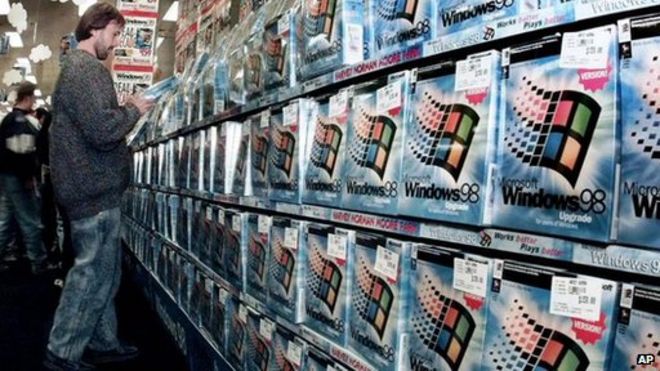
    Windows 98 launch
    The launch of a new version of Windows used to be a major event
    Windows 10 is going to be the last major revision of the operating system.
    Jerry Nixon, a Microsoft development executive, said in a conference speech this week that Windows 10 would be the "last version" of the dominant desktop software.
    His comments were echoed by Microsoft which said it would update Windows in future in an "ongoing manner".
    Instead of new stand-alone versions, Windows 10 would be improved in regular instalments, the firm said.
    Mr Nixon made his comments during Microsoft's Ignite conference held in Chicago this week.
    In a statement, Microsoft said Mr Nixon's comments reflected a change in the way that it made its software.
    "Windows will be delivered as a service bringing new innovations and updates in an ongoing manner," it said, adding that it expected there to be a "long future" for Windows.

    'No Windows 11'

    The company said it had yet to decide on what to call the operating system beyond Windows 10.
    "There will be no Windows 11," warned Steve Kleynhans, a research vice-president at analyst firm Gartner who monitors Microsoft.
    He said Microsoft had in the past deliberately avoided using the name "Windows 9" and instead chose Windows 10 as a way to signify a break with a past which involved successive stand-alone versions of the operating system.
    However, he said, working in that way had created many problems for Microsoft and its customers.
    "Every three years or so Microsoft would sit down and create 'the next great OS'," he said.
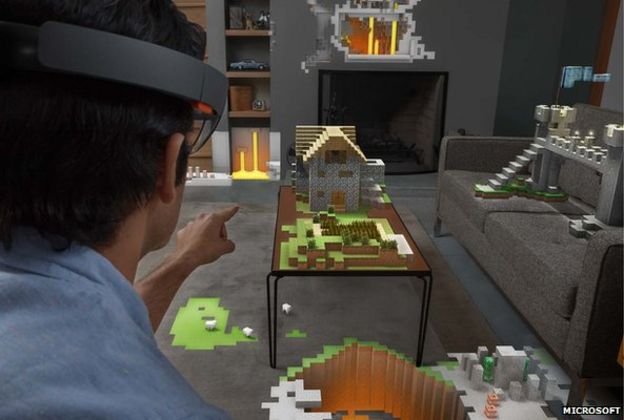
    Minecraft demo
    Microsoft has developed the HoloLens augmented reality system for use with Windows 10
    "The developers would be locked away and out would pop a product based on what the world wanted three years ago."
    Microsoft also had to spend a huge amount of money and marketing muscle to convince people that they needed this new version, and that it was better than anything that had come before, he explained.
    Moving to a situation in which Windows is a constantly updated service will break out of this cycle, and let Microsoft tinker more with the software to test new features and see how customers like them, he added.

    'Positive step'

    Most of the revenue generated by Windows for Microsoft came from sales of new PCs and this was unlikely to be affected by the change, Mr Kleynhans pointed out.
    "Overall this is a positive step, but it does have some risks," he said.
    "Microsoft will have to work hard to keep generating updates and new features, he said, adding that questions still remained about how corporate customers would adapt to the change and how Microsoft would provide support.
    "It doesn't mean that Windows is frozen and will never move forward again," Mr Kleynhans told the BBC.
    "Indeed we are about to see the opposite, with the speed of Windows updates shifting into high gear."
    Source:http://www.bbc.com/
    A team of Italian scientists turns ordinary spiders into super-spiders that can produce a web with fibers stronger than Kevlar. Hopefully the finding will also lead to a better Spider-Man movie.

    spiderweb.jpg
    An experiment in Italy yielded spider webs that contain what are believed to be the strongest fibers in the world. For those afraid of spiders, we apologize in advance for the dreams you're going to have tonight.

    Science stories like these are always a little concerning. They may have benefits that can bring mankind to new levels of scientific understanding. They may be able to produce finer goods with important applications. However, they are also the starting plot point of every B-grade horror movie about a giant animal attacking a major metropolitan city.
    Scientists at the University of Trento in Trento, Italy, found a way to make spiders produce even stronger webs -- so strong, they are hardier than Kevlar, the synthetic fiber used in bulletproof protection equipment, according to MIT Technology Review. How'd the researchers do it? By spraying the critters with carbon nanotubes and graphene flakes to turn them into super-spiders.
    Emiliano Lepore, a postdoctoral fellow who works in the university's department of mechanical and structural engineering, led the experiment. The team gathered 15 Pholcidae spiders, also known as cellar spiders or daddy longlegs, and sprayed them with water infused with the carbon nanotubes and graphene flakes. They compared the silk webs produced following the spritz with the control samples taken before the spiders were sprayed and measured their tensile strength with "a device that can measure the load on a fiber," according to MIT Technology Review.
    The fibers infused with the special water measured well above the control webs. In fact, they measured above synthetic fibers such as Kevlar, making them the strongest fiber known, according to MIT's report.
    The experiment could lead to some interesting discoveries about spiders, as well as new applications for spider silk, which is already known to be extraordinarily strong. The research hasn't figured out how the carbon nanotubes and graphene flakes made their way into the silk that produced the super-strong fibers in the webs. Lepore's team believes the spiders ingested the water containing the special materials, but they haven't been able to prove this theory using spectroscopic equipment.The fibers infused with the special water measured well above the control webs. In fact,they measured above synthetic fibers such as Kevlar, making them the strongest fiber known, according to MIT's report.
    The study could also be another step toward achieving a method of harvesting spider silk to create stronger materials in fields such as medicine, manufacturing and even public safety. Back in 2012, scientists working for the Forensic Genomics Consortium in the Netherlands produced a synthetic human skin that could stop bullets. The skin was made from the milk of genetically engineered goats and a protein found in spider silk.
    Spiders are also known for being able to make some of the strongest and toughest fibers in the world.Zoologist Ingi Agnarsson, who then worked with the University of Puerto Rico, discovered a new species of spider in 2010 called Caerostris darwini, also known as Darwin's bark spider, that could produce the strongest spider webs and the strongest's biological material known to mankind at that time, according to reports.
    These possible applications and advancements sound incredible, but personally, I just hope all of this leads to a better Spider-Man movie.
    Source:http://www.cnet.com/
    Tesla store

    Share This Article

    The average selling price of a new car in the US these days is $33,500, according to Kelley Blue Book. That’s not chump change, but it buys a lot of value. It’s roughly the price of a loaded-with-tech Honda Accord, Honda CR-V, or Toyota Camry, a bit above top-level Civics and Mazda 3s, and the starting point for entry-level BMW, Mercedes, and Audi models — although the latter often go out the door for much more, thanks to giant option sheets, and the fact that the Germans purposely make all sorts of things expensive options that come standard on mainstream cars, like backup cameras, leather seats, Bluetooth, and USB ports. (Or if you’re VW/Audi, you still don’t even offer USB ports.)
    So it’s significant that Tesla is still targeting $35K for its upcoming electric 3 Series fighter, the Model 3. And earlier this week, CEO and real-life Tony Stark character Elon Musk set March 2016 for its official unveiling, 10 months from now, in a conference call with financial analysts. An SEC filing in late April made it seem like the Model 3 will at least miss the 2017 model year, thanks to limits in manufacturing capacity. And Tesla certainly isn’t known for meeting its release date targets.
    The discussion always comes back to the price tag, though. It will make the Model 3 the least expensive Tesla ever — half that of the current base Model S 70D — but it certainly won’t be the least expensive electric car. The Nissan Leaf, the Mitsubishi i-MiEV, and lately with rebates, the Chevrolet Volt, all undercut it. But Tesla has the wind at its back, and the $35K Model 3 could really change the market for electric vehicles. Tesla is seen as a premium brand, and it’s pulling all sorts of stuff traditional automakers can’t, including direct sales, over-the-air (OTA) OS updates, a sophisticated super-fast charging network, and an ownership experience free of dealerships that profit on service. It’s any wonder people think Apple should buy the company.
    We still have no idea what the Model 3 will look like. All of the photos floating around are renderings. You can bet that a $35,000 Tesla won’t have autonomous driving, and it probably won’t crack the Model S‘s 270-mile range, although Musk has indicated 200 miles as a target — still way more than the Leaf and competing lower-cost models offer. The Volt always delivered more range, but it has a small gasoline engine that charges the batteries and occasionally helps power the car, so it’s a little more like a plug-in hybrid.
    2014 Tesla Model
    But we could easily picture a sleek, 178-inch-long version of the Model S with a still-giant touch screen on the center console and enough horsepower for a sprint to 60mph in 6.5 seconds or so. It will also be a good complement to the upcoming Model X all-wheel-drive crossover (shown above), which will go up against the BMW i3 and likely kill it on range, as a 1-2 strategy for moving downmarket. Right now, a lot of the focus is on Tesla’s push intohome backup energy with the Powerwall. If Tesla can pull off what Mercedes did with the CLA — make a gorgeous smaller car, even if it’s flawed in some ways — with the Model 3, the company may have to find a way to expand its automotive manufacturing capacity in a hurry.
    Source:http://www.extremetech.com/